How to Ask Customers for Google Reviews Without Being Annoying
Most tradespeople think asking for a review makes them look needy. The evidence says almost nobody minds.
In BrightLocal's 2026 Local Consumer Review Survey, 78% of consumers had been asked for feedback in the past twelve months, and 83% of those people left a review. Only 11% said no method at all would get a response out of them, according to BrightLocal's 2025 survey. Both polled US consumers, so read them as direction of travel rather than a UK headcount.
Your review problem is not persuasion. It is timing, frequency, and a surprising amount of law.
The short version
- Asking works. 78% of US consumers were asked last year and 83% of them wrote a review (BrightLocal, 2026).
- Ask everyone. Asking only your satisfied customers breaches Google's policy and CMA guidance.
- Never incentivise a Google review, even though UK law permits a disclosed one.
- One request, one reminder, an opt-out in every message. Then stop.
Does asking for reviews actually work?
Yes, by a wider margin than most trades expect. BrightLocal's 2026 survey of 1,002 US adults found 78% had been asked for feedback in the past year, and 83% of those asked wrote one. Only 11% told BrightLocal in 2025 that no method would prompt them at all.
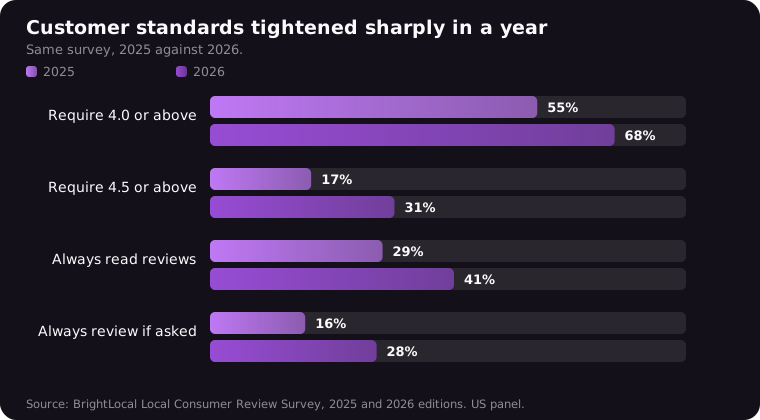
Willingness is climbing too. BrightLocal found 28% of US consumers will now "always" write a review when asked, up from 16% a year earlier. So the shortfall on your profile is rarely customer reluctance. It is that nobody asks.
On method, the evidence is thinner than the industry admits. BrightLocal's 2025 survey found US consumers most likely to leave a review when asked by email (40%), with in person second (27%). Every "SMS converts eight times better" claim traces back to a software vendor with no published methodology.
What does Google actually allow you to ask for?
Google's current policy is relaxed about asking and strict about steering. You can solicit genuine reviews from anyone. You cannot offer incentives, filter for the happy ones, pressure people on the premises, set staff review targets, or ask a customer to name a member of staff.
The permission, from Google's prohibited and restricted content policy:
"Solicit or encourage the posting of content that does represent a genuine experience, without offering incentives to do so or attempting to influence the rating or the contents of the review."
And the mechanics, from Google's tips to get more reviews: "To leave reviews, you can ask customers to visit a Google link or scan a QR code." So print the QR code on your invoices. That is Google's own recommendation, not a vendor's.
What crosses the line
The same policy tells merchants not to:
"Offer incentives, such as payment, discounts, free of cost goods and/or services, in exchange for posting any review"
"Discourage or prohibit negative reviews, or selectively solicit positive [reviews]"
"require or pressure users to leave ratings or write reviews while on the premises"
It also bans asking staff to "solicit a certain number of reviews", or to solicit reviews containing "content that identifies a staff member".
In working terms: "get me ten reviews this month, lads" is a violation, and so is "ask them to mention my name". Handing someone a tablet and waiting is pressure on the premises. A customer who names your fitter unprompted is fine.
Is it legal to ask UK customers for reviews?
Yes, and the regulator says so in writing. The CMA's fake reviews guidance, CMA208, published 4 April 2025, confirms a plain request is lawful. What is not lawful is deciding in advance which customers get asked, or what they are going to say.
Para 3.6 is the line to keep in your back pocket:
"Doing so without predetermining the contents or sentiment expressed in the review, for example by merely emailing customers generally to ask if they wish to provide a review, is not prohibited under the banned practice."
The banned practice it refers to sits in Schedule 20 of the DMCC Act 2024, in force since 6 April 2025. It covers fake reviews, undisclosed incentivised reviews and publishing reviews in a misleading way. Because it is banned outright, the CMA does not have to prove it changed anyone's behaviour.
The stakes are UK-sized. The CMA reported in January 2025 that 89% of UK consumers use online reviews when researching, and that as much as £23 billion of UK consumer spending a year is potentially influenced by them.
Review gating is named in the guidance
Para 4.5 covers the tactic of surveying customers first and sending the Google link only to the ones who scored you well:
"Cherry picking positive reviews for publication over negative ones might be done either through suppressing negative reviews that have been submitted or by encouraging just those who are satisfied to leave reviews."
Para 4.4 adds one more: never make dispute resolution conditional on a customer not leaving a negative review. Fixing a job should not come with a review clause attached.
Where UK law and Google's rules pull apart
This is the one place where obeying the law is not enough. UK law permits incentivised reviews under two conditions. Google bans them outright, with no conditions. So an offer that is perfectly legal in Britain can still cost you every review on your profile.
The divergence, in one example
You offer "£10 off your next job if you leave us a review", and you disclose the incentive. Under CMA208 para 3.7 that complies with UK law, as long as the review reflects the customer's genuine experience. Under Google's policy it is a straight breach, because you offered a discount in exchange for a review.
Do not incentivise Google reviews at all.
CMA208 anticipates the collision. Para 3.4 notes that "many publication media... do not allow incentivised reviews", and that where a platform prohibits them, "submitting an incentivised review is likely to be misleading". The platform rule does not merely sit beside the law. It can pull you back inside it.
The CMA defines an incentive broadly. Para 2.10 covers cash, commissions, discounts, vouchers, freebies, favourable loans and event invitations, and includes asking your own staff to write a review.
There is a carve-out. Footnote 8 says prize draw entry, which guarantees no direct benefit, "is unlikely to amount to commissioning". That is a UK-law safe harbour, not a Google one, because Google's wording covers reviews paid for directly or in kind. The carve-out exists. We would not use it.
What happens to a UK profile that breaks the rules
Google has already agreed the punishment with the UK regulator. Under undertakings secured by the CMA in January 2025, Google will place prominent warning alerts on UK business profiles using fake reviews, deactivate their review function, and, for repeat offenders, delete all their reviews for six months or longer.
Read that last part again. Not the fake ones. All of them. Every genuine five-star write-up you spent three years earning, gone for half a year, on a profile carrying a public warning label.
Enforcement is not theoretical either. Google reported blocking or removing over 292 million policy-violating reviews in 2025, plus more than 13 million fake Business Profiles.
When the fake reviews are someone else's and aimed at you, the process is different, and dealing with a competitor's fake reviews starts with checking they really are fake.
Can you text or email customers for a review?
Usually yes, if the details are yours and the message behaves itself. PECR Regulation 22 governs "electronic mail", which covers both email and SMS. Its soft opt-in permits contact where you obtained the details during a sale or negotiations for one, and offered a free way to refuse.
Be straight about the uncertainty. Whether a review request counts as direct marketing under PECR is genuinely unsettled, and advisers disagree. Treat what follows as conservative practice rather than a ruling.
- Only contact people whose details you collected yourself, during the quote or the job.
- One request, plus at most one reminder. Then stop, whatever your software suggests.
- Put an opt-out in every message. One line will do.
- Never buy or borrow a list. Not from a merchant, not from a lead site.
Read that list again. Every item is also the answer to "how do I avoid being annoying". The compliant way and the non-annoying way are the same way, which makes this the rare piece of regulation that pays for itself.
What star rating do customers actually expect?
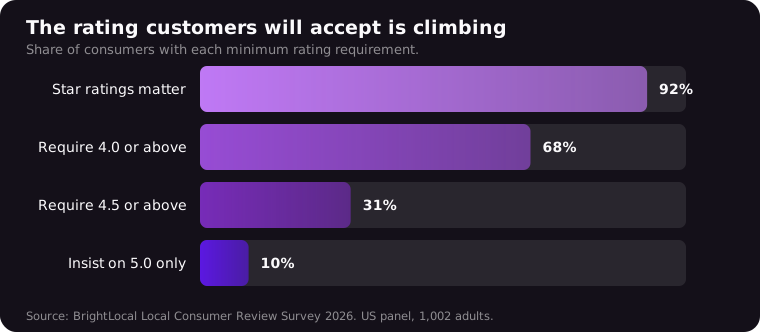
Higher than a year ago, and the bar is climbing fast. BrightLocal's 2026 US survey found 68% of consumers require a minimum four-star rating, up from 55%, while 31% now want 4.5 or better, up from 17%. One in ten will accept nothing below a perfect 5.0.
| What US consumers say | 2025 | 2026 |
|---|---|---|
| Require at least 4.0 stars | 55% | 68% |
| Require at least 4.5 stars | 17% | 31% |
| Insist on a perfect 5.0 | not published | 10% |
| "Always" read local business reviews | 29% | 41% |
| "Always" leave a review when asked | 16% | 28% |
Those thresholds describe what customers will accept when choosing, not how many people click your listing. Nobody has published reliable evidence on the click-through question, so we are not going to invent it.
Chasing a flawless 5.0 is still the wrong target. The Medill Spiegel Research Center at Northwestern found in 2017 that purchase likelihood peaks between 4.0 and 4.7 stars, then falls as ratings approach 5.0. Two caveats: the popular "4.2 to 4.5" version of that finding comes from a press release rather than Spiegel's own page, and Spiegel studied e-commerce products, not local trades. It supports "you do not need to be perfect" by analogy only.
Volume counts as well. Spiegel found purchase likelihood with five reviews was 270% greater than with none, and 47% of BrightLocal's 2026 US respondents would not use a business with fewer than 20 reviews.
Since a perfect score is not the target, plan now for how to reply when a bad review lands.
Timing, frequency and pressure decide whether you are annoying
Not the channel. Recency is your strongest timing argument: 74% of US consumers in BrightLocal's 2026 survey prioritise reviews from the last three months, and 44% weight the last month heavily. A steady trickle beats an annual blitz, on manners and on results.
Ask once, at the point the customer is happiest, usually when the job is finished, tested and tidied. Not three weeks later from an automation. Not while you are packing the van and they are looking at the mess. Send the link the same day, or point them at the QR code on the invoice. Then leave it alone. One reminder a few days later at most, and never a third.
Replying badly is its own kind of annoying
BrightLocal's 2026 US data found 80% of consumers are more likely to use a business that responds to all its reviews, but 50% are put off by generic responses. Speed matters too: 32% expect a reply within a day, up from 18%. Name the actual job. Twenty specific words beat a paragraph of template.
Frequently asked questions
Can I ask only my happy customers?
No. Google's policy bans selectively soliciting positive reviews, and CMA208 para 4.5 names "encouraging just those who are satisfied to leave reviews" as cherry picking. Ask everyone, the same way, every time. That consistency is also your defence if anyone questions your process later.
Is offering a discount for a review illegal in the UK?
Not automatically. CMA208 para 3.7 permits incentivised reviews if you disclose the incentive and the review reflects genuine experience. Google bans incentives outright, though, so a lawful offer can still get your reviews removed. For Google specifically, do not incentivise.
Can I run a prize draw for reviewers instead?
UK law treats it more leniently. CMA208 footnote 8 says prize draw entry, guaranteeing no direct benefit, is unlikely to amount to commissioning. Google's policy still covers reviews paid for directly or in kind, which leaves the tactic exposed. The carve-out exists. We would not rely on it.
How many times can I chase a customer?
Once, then one reminder. PECR requires a simple opt-out in every message where the soft opt-in applies, and the CMA warns against arbitrarily stopping and starting review invitations. Past two contacts you are not persuading anybody, you are training them to ignore you.
What to do this week
Six things, none of them expensive.
- Get your Google review link and save it to your phone. Google endorses both a short link and a QR code, so print the code on your invoices too. Our free Google review link generator makes both, plus printable review cards to leave with each job.
- Fix the moment. Job finished, tested, tidied, same day. A step in the process, not a mood.
- Ask every customer. No filtering, no pre-screening survey, no deciding who seems happy.
- Withdraw any incentive you are offering. Discounts, vouchers, money off the next job. All of it, disclosed or not.
- Cap follow-ups at one and add a one-line opt-out to your template. Only message people whose details you collected yourself.
- Reply within a day, specifically. Mention the job. Half of consumers are put off by generic replies, so a template is worse than a slightly late human answer.
The unglamorous truth is that review generation is not a growth hack. It is a habit, applied to every customer, for years. We build it into client processes at Business Opt because no amount of profile work rescues a trade sitting on eleven reviews with nothing since 2024.
Ask everyone. Ask once. Then get back on the tools.