Getting Recommended by ChatGPT, Perplexity and AI Overviews
Somebody has emailed you about getting your business into ChatGPT. The email contained a percentage. There is a fair chance that percentage does not exist.
This corner of search carries more confident fabrication than any other. So where nobody has published an answer, this article says exactly that.
Start with the number that reframes the subject. The Competition and Markets Authority found Google's AI Overviews reached significantly more users, and appeared more frequently, than all ChatGPT queries combined. It described chatbot search use as "very low" next to Google (CMA Final Decision, October 2025, quoted in Ofcom's The Era of Answer Engines).

This is the state of play as at July 2026. Things will move. The honest bits will not.
The short version
- AI Overviews reach more UK users than every ChatGPT query combined (CMA, October 2025). Your Google work is your AI search work.
- The only solid study on citation factors scored keyword stuffing at 17.7, below the 19.3 do-nothing baseline.
- Google states in writing that no special schema and no AI text file are needed.
- Nobody has published how any AI system picks a local business to recommend.
How much of UK search is actually AI?
Less than the pitch decks suggest. Ofcom, citing Ipsos iris, found 15.8m UK online adults, 32%, visited at least one AI chatbot in June 2025 (Ofcom, The Era of Answer Engines, November 2025). Google Search still handles roughly 90% of UK search queries.
ChatGPT is genuinely large. The same data puts it at 13.0m UK online adults in June 2025, up from 4.4m a year earlier. Ofcom's Online Nation 2025 recorded 1.8bn UK visits to ChatGPT in the first eight months of 2025, against 368m the year before.
Now the rest of the field. Perplexity reached 560,979 UK adults. Claude.ai reached 345,735. Those are not typos.
AI Overviews are a different animal. Around 30% of searches show one, and 53% of UK adults say they see these summaries often (Ofcom, Online Nation 2025, December 2025).
So where should a UK trade actually spend the effort?
On ordinary Google Search and Business Profile work. Treat that as our inference, not a published finding. The reasoning rests on Tier 1 regulator data: the CMA found AI Overviews reached significantly more users, and appeared more often, than all ChatGPT queries combined (CMA Final Decision, October 2025, via Ofcom).
Here is why it follows. AI Overviews and AI Mode run on Google's own index and Gemini models. If Google cannot crawl you, index you or find you credible, you are not in the AI answer either.
So the unglamorous work has not changed. Categories, services, reviews, hours, service pages that describe what you actually do and where you actually go.
There is no new lever here. There is the old lever, doing more jobs than it used to.
How does each AI system find local businesses?
Three separate plumbing systems, and the difference matters more than any content tweak. Ofcom's November 2025 paper documents it. AI Overviews run on Google's own index and Gemini models, ChatGPT "accesses live search data via Bing's search API", and Perplexity operates its own independent index.
Google AI Overviews and AI Mode
Built on Google Search. Google's documentation says AI Mode "uses the power of the Knowledge Graph and Google Maps", which puts your Business Profile directly in the supply chain.
Maps is heading the same way. Google said in December 2025 that it is rebuilding Business Profile Q&A around AI answers.
ChatGPT
Retrieval runs through Bing's search API, and OpenAI names OAI-SearchBot as the agent that "powers ChatGPT's search features" (OpenAI crawler documentation).
A Yelp licensing deal covering reviews, ratings, photos and Request a Quote was reported on 23 July 2026 (Axios, with Search Engine Land downstream of the same scoop). Read it carefully. Neither source states a launch date or a geographic scope, and Yelp's UK trades footprint is small. Do not reorder your week around it.
Perplexity and Claude
Perplexity runs its own index. PerplexityBot, "designed to surface and link websites in search results", respects robots.txt. Perplexity-User fetches on user request and "generally ignores robots.txt rules" (Perplexity bot documentation). Claude, at 345,735 UK adults, is not a priority channel for a UK trade.
What actually makes an AI system cite a page?
The strongest evidence available is one academic paper, and its most useful finding is awkward for the industry. Keyword stuffing scored 17.7 against a 19.3 no-optimisation baseline (Aggarwal et al., GEO: Generative Engine Optimization, KDD 2024). Stuffing performed worse than doing nothing.
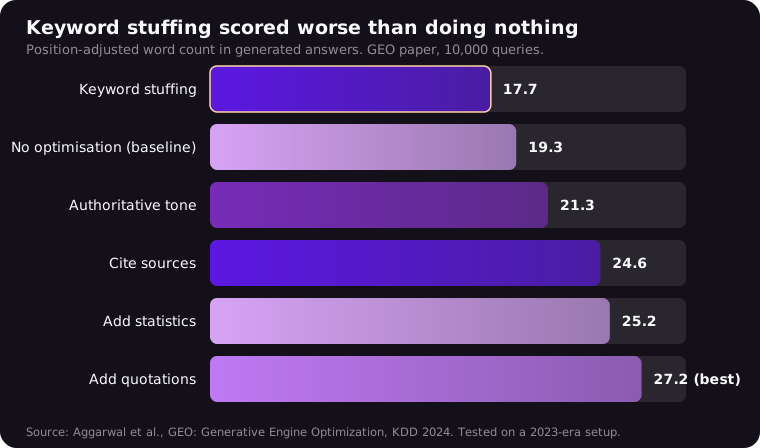
The benchmark covered 10,000 queries across 25 domains, nine query types and five random seeds.
| Method | Position-Adjusted Word Count | Subjective Impression |
|---|---|---|
| No optimisation (baseline) | 19.3 | 19.3 |
| Keyword stuffing | 17.7 (below baseline) | 20.2 |
| Authoritative tone | 21.3 | 22.9 |
| Cite sources | 24.6 | 21.9 |
| Statistics addition | 25.2 | 23.7 |
| Quotation addition | 27.2 (best) | 24.7 (best) |
The authors report a relative improvement of 30-40% for citing sources, adding quotations and adding statistics, with real-world validation on Perplexity showing gains up to 37%.
One serious caveat. This ran on a GPT-3.5-turbo retrieval setup over the top five Google results, a 2023-era configuration, not the live systems you are trying to reach. Treat the direction as sound and the decimals as history.
Ahrefs' December 2025 study of 75,000 brands found branded web mentions correlated at 0.664 with ChatGPT visibility, well ahead of backlink counts (Ahrefs, December 2025). The authors say it themselves: "correlation isn't causation". The sample also excluded sites below Domain Rating 40, which is essentially every UK sole trader. The coefficients do not transfer to a Croydon plumber.
Do you need special schema to appear in AI Overviews?
No, and Google says so in writing. Its documentation states there are "no additional requirements to appear in AI Overviews or AI Mode, nor other special optimizations necessary", and adds: "You don't need to create new machine readable files, AI text files, or markup... There's also no special schema.org structured data that you need to add" (Google Search Central).
That quote kills most of the AI schema industry. Google, on Google's own product, in Google's own documentation.
Schema is still worth doing. It earns rich results and keeps your business details accurate. Those are good reasons. "It gets you cited by AI" is not one of them, on the vendor's own evidence.
The same applies to advice about writing tidy 40 to 60 word answer chunks. No study with a stated methodology supports a specific passage length. Craft advice, not a finding.
Is llms.txt worth an hour of your time?
Probably not as a citation lever. Ahrefs studied 137,210 domains in May 2026 and found 97% of llms.txt files received zero requests (Ahrefs llms.txt study). Among the files fetched at all, the largest requester was SEO audit tools at 21.7%, not AI assistants.
Only 19.5% of those fetches came from named AI tools. GPTBot accounted for 4.51%.
Google's John Mueller called llms.txt "purely speculative for now", noting that "the file has existed for years, yet none of the AI systems use it" (Search Engine Journal, June 2026).
One fairness point. Ahrefs Web Analytics domains skew SEO-active, so the 28% adoption rate runs far above the web at large. The 97%-zero-requests finding is unaffected by that.
An llms.txt costs an hour and does no harm. Anyone selling it as an AI SEO service is selling something no AI vendor has confirmed reading.
Which crawlers should your robots.txt allow?
Allow the search crawlers, then make a business decision about the training ones. The costliest mistake is blocking the wrong OpenAI token. Blocking GPTBot excludes you from model training but does not remove you from ChatGPT search. Blocking OAI-SearchBot does (OpenAI crawler documentation, retrieved July 2026).
Check that today. Many WordPress security plugins and Cloudflare presets block AI bots by default, and they commonly conflate the two.
| Token | Purpose | Effect of blocking |
|---|---|---|
OAI-SearchBot | Powers ChatGPT search | You will not appear in ChatGPT search answers |
GPTBot | OpenAI model training | Training only. ChatGPT search unaffected |
ChatGPT-User | User-initiated fetches | Not governed the same way |
PerplexityBot | Perplexity search index | Removed from Perplexity. Respects robots.txt |
Perplexity-User | User-requested fetches | Generally ignores robots.txt. Needs firewall blocking |
Claude-SearchBot | Claude search quality | Removed from Claude search results |
ClaudeBot | Anthropic model training | Training only |
Google-Extended | Gemini training control | No effect on Search or AI Overviews |
Googlebot | Google Search crawling | Removed from Search, and therefore AI Overviews |
Google is explicit that "Google-Extended does not impact a site's inclusion in Google Search nor is it used as a ranking signal" (Google crawler documentation). AI Overviews are built on the Search index, so blocking Google-Extended does not remove you from them. Blocking Googlebot does.
The legacy tokens anthropic-ai and Claude-Web no longer appear in Anthropic's current documentation. Ignore any checklist still listing them.
As a recommendation rather than a finding: allow OAI-SearchBot, PerplexityBot, Claude-SearchBot and Googlebot. Treat the two training tokens as a judgement call, since blocking them costs nothing in search visibility per the vendors' own docs.
Trades are among the most AI-Overview-exposed local categories
Local Falcon's May 2025 study of 4,423 businesses across 20 countries and 60,000 queries, using 7x7 grids, found AI Overviews on 40.2% of local queries overall. Two cleaning trades topped the exposure table: window cleaning at 65.0% and carpet cleaning at 64.6%.
If you have seen 68% quoted as the local AI Overview rate, we cannot trace a source for it. The defensible figure is 40.2%.
The more interesting finding concerns distance. Local Falcon measured effectively no correlation, 0.001, between how far a business sat from the searcher and its position in the AI Overview. In the traditional local pack, proximity is among the strongest factors there is.
That cuts both ways. Being nearest is not the shortcut it usually is. Being further out is not the handicap it usually is either.
Should a UK trade bother with Bing?
Possibly, and this is reasoning rather than a documented finding. Two Tier 1 facts sit underneath it. Ofcom documents that ChatGPT accesses live search data via Bing's search API (November 2025). The CMA puts Bing at under 5% of UK search (October 2025).
Our inference from those two facts: a UK trade could be well optimised for Google and simultaneously absent from ChatGPT's retrieval layer, because nobody in the business ever had a reason to think about Bing.
If that is right, claiming Bing Places and Bing Webmaster Tools is cheap insurance. The facts are sourced. The conclusion is ours, and no published study measures how much difference it makes.
What nobody has actually published
More than your inbox suggests. No AI vendor has published how it selects which local business to recommend. Not OpenAI, not Google, not Perplexity. Any article claiming to know ChatGPT's local ranking factors is guessing, however precise the numbers look.
The genuine gaps, stated plainly:
- How any AI system picks a local business to recommend. Undocumented by every vendor.
- Whether Business Profile completeness affects AI Overview inclusion. Undocumented. The repeated "post every 30 days or lose AI visibility" claim has no sourced basis at all.
- Whether UK consumers use AI to find a tradesperson. No UK data exists. BrightLocal found 45% of US consumers had asked an AI tool for a local business recommendation in the past year (March 2026, n=1,002, US respondents). US data, about local businesses generally.
- The role of Checkatrade, MyBuilder, Trustpilot and Which? Trusted Traders in AI answers. Entirely undocumented. Whitespark's review-source research is a US list. Rated People has dropped off this list. Its trade memberships closed after the company passed a resolution to wind itself up in September 2026.
- Whether ChatGPT supplements Bing with other sources. Unresolved.
Figures we will not repeat as fact: "68% of local queries show AI Overviews", "13.7% citation overlap between AI Mode and AI Overviews", "Foursquare supplies 60-70% of ChatGPT local results", and "ChatGPT-referred sessions convert at 15.9%". No primary source traced for any of them.
A fifth, "AI Mode surfaces 32% fewer local businesses than the map pack", does have a source, but it changed on the way. Sterling Sky's December 2025 count had nothing to do with AI Mode. It compared the AI-powered local packs Google was rolling out on US mobile searches with normal three-packs, and found about 32% as many businesses in them, 5,943 against 18,330. That is roughly 68% fewer.
Frequently asked questions
Will an llms.txt file get me into ChatGPT?
No published evidence says so. Ahrefs found 97% of llms.txt files across 137,210 domains received zero requests in May 2026, and Google's John Mueller called the format "purely speculative for now". It does no harm. It is not a citation lever.
Should I block AI crawlers to protect my content?
Depends whether you mean training or search. Per OpenAI's documentation, blocking GPTBot stops training use without affecting ChatGPT search. Blocking OAI-SearchBot removes you from ChatGPT search answers entirely. Check which one your security plugin blocked by default.
Do I need to post to my Business Profile every 30 days for AI visibility?
There is no sourced basis for that claim. Whether profile completeness or posting frequency affects AI Overview inclusion is undocumented by Google. Posting is defensible for other reasons. The 30-day AI rule was invented somewhere and repeated since.
Are 45% of my customers using AI to find a tradesperson?
Almost certainly not, on the available evidence. BrightLocal's 45% is US consumers, n=1,002, asked about local businesses generally in March 2026. No UK data exists on people using AI to find a tradesperson specifically.
What to do this week
Weighted deliberately towards the boring work, because that is where the evidence points.
- Spend most of the time on your Google Business Profile. Categories, services, hours, photos, service areas. AI Mode runs on the Knowledge Graph and Maps, so this is AI work whether anyone bills it that way or not.
- Keep asking for Google reviews. Same reasoning. It feeds the index everything else is built on.
- Open your robots.txt and search for
OAI-SearchBot. If a plugin or a Cloudflare preset blocked it, you are out of ChatGPT search answers. Ten minutes. - Rewrite one service page properly. Cite the manufacturer guidance or building regulation you work to, quote it, include the real figures. That is what the GEO benchmark rewarded. Stuffing is what it punished.
- Claim Bing Places and Bing Webmaster Tools. Our inference, not a finding, but it costs an evening.
- Skip llms.txt unless you have a spare hour and nothing better to do.
At Business Opt we run that order on every trades account, because the Google fundamentals do the AI job as a side effect and no separate AI product has yet been shown to beat them.
The honest summary as at July 2026: get found properly on Google, and you have done most of what anyone can currently prove about getting found by AI.