
How to Choose the Right Google Business Profile Category
Most tradespeople spend an afternoon fussing over their business description and about four seconds picking their category. That is backwards.
The primary category has been voted the single strongest local pack ranking factor in the industry's best-known expert survey, two editions running. Yet BrightLocal's 2023 study of 1,050 locations found electricians used fewer additional categories than any other trade it measured, an average of 1.0.
One dropdown. Ten seconds of clicking. It decides which searches you can appear in at all.
Here is what the evidence actually says, including the part where the experts flatly disagree.
The short version
- Your primary category is the #1 local pack ranking factor in Whitespark's expert survey, ahead of even proximity.
- Treat it as a switch, not a dial. It sets which searches you are eligible for.
- Google says use as few categories as possible. Sterling Sky says fill every slot. BrightLocal's 2023 data peaked at four additional categories.
- Choose what your business is, never what it sells.
Why does your primary category matter more than anything else on your profile?
Because the people who study this for a living rank it first. Whitespark's Local Search Ranking Factors 2023, a survey of 44 local SEO experts scoring 149 separate factors, put the primary Google Business Profile category at number one for local pack rankings, as reported by Barry Schwartz at Search Engine Land in March 2023.
It beat proximity to the searcher, the one thing on that list you cannot control at all.
The 2026 edition kept it at the top. According to BrightLocal's summary of the local ranking factors, updated in January 2026, the primary category still ranks first, with proximity second and keywords in the business title third. That 2026 ordering is quoted from BrightLocal's write-up rather than the original survey page.
Additional categories sit further down that 2026 list, at number eight. Still useful. Not the main event.
Your primary category is a switch, not a dial
A dial makes you gradually more relevant. A switch decides whether you are in the room. Your primary category behaves like the second one: it largely determines which searches your profile is eligible for, rather than nudging you up or down within searches you already compete in.
If you are a heating engineer earning your living from boiler repairs, but your primary category points at installation, you are not "slightly less visible" on repair searches. You may be a much weaker candidate for that entire query set, however many reviews you have collected.
Google's own guidelines for representing your business give the cleanest test ever written for this. Choose the category that completes the sentence "this business is a", not "this business has a". A plumber who sells parts is not a plumbing supply store. A builder with a yard is not a builders' merchant.
The guidelines add a rule people miss: selecting a specific category automatically includes the broader parent categories above it. Adding the vague umbrella term as well does nothing.
Specific beats broad, every time
Google's en-GB help page on managing your business category tells you to pick the specific option over the general one. Its own example is choosing "Nail salon" rather than "Salon". For trades, that means the named service line rather than "Contractor".
How many categories should you actually use?
There is no settled answer, and anyone who gives you one is guessing. Google's guidelines say use as few as possible. Sterling Sky's testing says fill every available slot. BrightLocal's 2023 data on 1,050 locations landed between the two, with four additional categories producing the best average rank.
The profile interface allows one primary plus up to nine additional categories, ten in total, as documented by both BrightLocal and Sterling Sky. Google's published guidelines do not state a numeric cap themselves.
Here are the three positions, fairly stated.
What Google says
"Use as few categories as possible to describe your overall core business from the provided list." Google also says not to use categories solely as keywords, or to describe attributes of the business. The en-GB help page is blunter still: do not select a category for every product or service you offer.
What Sterling Sky says
The opposite, more or less. In their August 2025 write-up on how many categories to use, Joy Hawkins argues for filling all ten slots, because their testing does not support the popular "category dilution" theory. In one case, a landscaper added Landscape Designer, Landscape Architect and Retaining Wall Supplier as secondaries and began ranking for those terms.
What BrightLocal's data shows
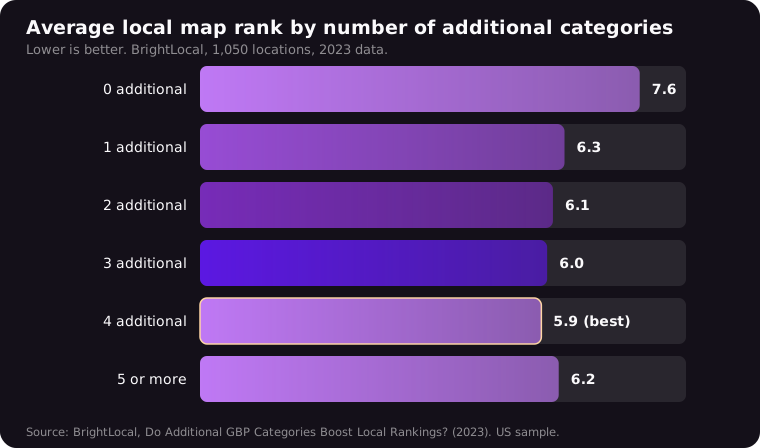
BrightLocal's June 2023 study measured 1,050 locations across seven primary categories, 150 locations each, using a 7x7 local search grid at 500 metre spacing and ten keywords per location. Average local map rank by number of additional categories came out like this. Lower is better.
| Additional categories | Average local map rank |
|---|---|
| 0 | 7.6 |
| 1 | 6.3 |
| 2 | 6.1 |
| 3 | 6.0 |
| 4 | 5.9 (best) |
| 5 or more | 6.2 |
Read that shape carefully. The enormous gain is going from zero to one. After that the curve flattens, peaks at four, then ticks slightly worse at five or more.
BrightLocal's own October 2025 guidance is to add only genuinely appropriate secondary categories rather than all nine available. That sits closer to Google than to Sterling Sky, but a long way from "as few as possible".
One honest caveat. That quantified dataset is from 2023 and its sample was US locations. Treat the direction of travel as reliable and the decimal points as historical.
What happened when one HVAC firm changed its primary category?
It fell from position one to position 31 overnight, then recovered in roughly two weeks after reverting. Joy Hawkins documented this in Sterling Sky's checklist for optimising a Google Business Profile in May 2025. The business had switched its primary from "Air Conditioning Repair Service" to "Air Conditioning Contractor".
Two categories describing what most people would call the same company. Thirty places between them.
Say plainly what this is: a single-client observation, not a controlled experiment. No control group, no isolation of other variables. One profile, one change, one outcome.
It is still worth your attention. The effect is far too large to be background noise, and it matches the survey data, where the primary category outranks everything else. That is the switch behaving like a switch.
The lesson is about risk, not air conditioning. Change your primary, watch what happens, and be prepared to put it back.
Which category mistakes do UK tradespeople make most?
The common ones are predictable and cheap to fix. Under-filling is the biggest, given BrightLocal's 2023 finding that profiles with zero additional categories averaged rank 7.6 against 5.9 for those with four. Electricians averaged just 1.0 additional categories, the lowest of any vertical in that study.
Choosing what you sell instead of what you are. "Plumbing supply store" when you are a plumber. Google's "is a" test kills this one in seconds.
Hiding behind an umbrella term. "Contractor" feels safely broad. Broad is not safe. It puts you in a bigger, vaguer pool while the specific category sits there unused.
A primary that does not match your money job. Plenty of trades earn their living from emergency call-outs but have a category built around planned installation work, or the reverse.
Using categories as keywords. Stuffing in loosely related categories to chase search terms is explicitly against Google's guidelines. It is also the one mistake here that can cost you the profile rather than just some rankings.
Setting it once and forgetting it. More on that below.
Letting somebody else change it. A web developer or a directory listing service editing your primary category can undo months of work. Changes can also trigger re-verification, which takes your profile out of action while you sort it.
Copying a US category list off a blog. The en-GB list is its own list, with different names and availability. Check yours against a live tool such as PlePer's category browser with the country set to the UK.
The category sits beside one other setup choice that deserves the same care: whether your profile shows a service area or address.
Do Google's categories change after you set them?
Constantly. Sterling Sky's rolling tracker of category changes, current to July 2026, logs 15 categories added in the first seven months of 2026 alone, with three renamed and one removed. Across 2025 it recorded 11 added and six renamed. Google maintains over 4,100 categories in total.
UK-relevant examples from that tracker: "Vauxhall dealer" was added in 2025, "Childminder" was renamed to "Babysitter" in 2026, and "Moving company" became "Moving services".
Why this matters. A category that did not exist when you set up your profile may now describe your work better than anything available at the time. Nobody emails you about it.
A twenty minute check twice a year is enough. Diary it.
Frequently asked questions
Can I change my primary category without wrecking my rankings?
You can, but treat it as a live change rather than admin. Sterling Sky's May 2025 case saw an HVAC firm fall from #1 to #31 overnight after a primary category switch, recovering in about two weeks once reverted. Change one thing, watch your enquiries, and be ready to revert.
Should my category match my main keyword?
No. Google's guidelines specifically say not to use categories solely as keywords or to describe attributes of your business. Pick the category that describes what the business is. Keywords belong in your description, services and website content, where they are supposed to live.
Do extra categories dilute my primary one?
The evidence disagrees with itself. Sterling Sky's testing found no support for dilution and recommends filling all ten slots. BrightLocal's 2023 data showed the best average rank at four additional categories, with five or more slightly worse at 6.2 versus 5.9. Both agree that zero is the worst option.
Is the UK category list the same as the American one?
No. The en-GB list is distinct, with different names and availability. Check the live list with the country set to the UK before committing to a category name you read in a US blog post.
What to do this week
A short list, honestly ordered.
- Open your profile and read your primary category out loud with the words "this business is a" in front of it. If the sentence is a lie, that is your whole problem.
- Check your last twenty invoices. Does your primary category match where the money actually comes from, or where you wish it came from?
- Look at the en-GB category list for something more specific than what you have got. Specific beats broad.
- Count your additional categories. If it is zero or one, that is the cheapest improvement available to you today. Add only categories that genuinely describe services you provide.
- Do not stuff. Anywhere from four additional categories up to a full ten is defensible, provided every one is true. Nine invented ones are not.
- If you change your primary, note the date and watch your call volume for a fortnight. Revert quickly if it drops.
If the category checks out and the phone still is not ringing, work through the other reasons a profile gets views but no calls.
The unglamorous truth is that this is a twenty minute job that outweighs most of what agencies sell alongside it. At Business Opt we check the category before touching anything else on a trades profile, because there is no point optimising a listing that is competing in the wrong set of searches.
Get the switch right first. Everything else is a dial.