
The Service Page Structure That Actually Ranks Locally
Nearly every trade that has paid for SEO has been sold the same thing. A page for every town within an hour of the yard. Forty pages. Sometimes sixty.
Then the worry starts. Is this a doorway page? Will Google penalise the whole site because an agency spun out "Emergency Plumber in Chigwell" from a template?
Most articles answer that with a number they invented. This one will not. Google's spam policies never mention a page count. They test for substantially similar pages instead, and that is something you can check yourself in ten seconds.
The short version
- Google's doorway policy targets "substantially similar pages", not a page count. Swap the town name and read it again.
- Service pages sit on safer ground than town pages. Nothing in the policies discourages one page per distinct service.
- Titles of 51 to 60 characters had the lowest rewrite rate in Zyppy's 2022 study. Over 70 characters, Google rewrote 99.9% of them.
- No credible study measures word count against local service page performance. Anyone quoting you a target is guessing.
Where is the line between a service page and a doorway page?
The line is similarity, not quantity. Google's spam policies define doorway abuse as pages "created to rank for specific, similar search queries" that "lead users to intermediate pages that are not as useful as the final destination". Nowhere does Google publish a threshold number of pages.
The listed examples are more specific. Google names "having multiple domain names or pages targeted at specific regions or cities that funnel users to one page", and "creating substantially similar pages that are closer to search results than a clearly defined, browseable hierarchy".
That first one describes the classic town-page set exactly. Thirty pages whose only job is to hand the visitor to one contact form. The pages are not the destination. They are a turnstile.
The substitutability test
Take any town page, swap the town name for a different town, and read it again. If it reads identically, the page is "substantially similar" by Google's own wording. You have not written thirty pages. You have written one page thirty times.
Most template pages fail immediately. A page that passes contains things that could not be moved: a job on a specific street, the parking, the local housing stock.
Why scaled content abuse is the sharper policy now
The doorway rule needs that funnelling behaviour. The newer rule does not. The same page defines scaled content abuse as "when many pages are generated for the primary purpose of manipulating search rankings and not helping users", and lists "using generative AI tools or other similar tools to generate many pages without adding value".
No turnstile required. A sixty-town set spun from a template, with or without AI, falls under that wording on its own. It is the more likely enforcement route now.
Service pages sit on safer ground than town pages
Worth saying plainly, because the anxiety attaches to the wrong thing. Nothing in Google's spam policies discourages one page per distinct service. The policies target near-duplicate geographic variants. A boiler repair page and a bathroom installation page describe different work for different customers.
The service area cap that reinforces the point
Google Business Profile also caps how far you can claim to work. Under Google's guidelines for representing your business, a service area should sit within roughly two hours' driving time of the business.
Compare that to a site claiming sixty towns. The profile cannot support it. The van cannot support it. That is a coverage claim the business cannot substantiate.
How long should a local service page be?
Nobody knows, and that is the honest answer. No credible study measures word count against local service page performance. General content-length studies exist, but none segment local intent, so they say nothing about a boiler repair page in Walthamstow.
Google's own guidance on creating helpful content specifies no word count anywhere. Not a minimum, not a range. It asks questions instead.
"Does your content clearly demonstrate first-hand expertise and a depth of knowledge?" And: "Is the content mass-produced by or outsourced to a large number of creators?"
That second question is aimed squarely at templated page sets. So write until the customer's questions are answered, then stop. The page might run 500 words. It might run 1,200.
If a competitor tells you the magic figure is 800 words, ask them for the study. There isn't one.
How should you write the title tag and H1?
Keep the title between 51 and 60 characters and make the H1 agree with it. Zyppy's study of 80,959 titles across 2,370 sites found Google rewrote 61.6% of titles overall, but the 51 to 60 character band had the lowest rewrite rate, roughly 39 to 42% (Zyppy, 2022). Not a UK-specific sample.
The tails are brutal. Titles over 70 characters were rewritten 99.9% of the time, and titles of one to five characters 96.6%. Write a 90-character title stuffed with three towns and you are not writing a title, you are writing a suggestion Google will ignore.
Separators matter too. Pipes were removed or replaced 41.0% of the time against 19.7% for dashes, and square brackets 77.6% against 61.9% for parentheses.
Make your H1 agree with your title
This is the finding worth acting on today. When a number appeared in both the title and the H1, Google preserved it 97.3% of the time. When it appeared in the title alone, preservation fell to 74.2% (Zyppy, 2022).
Corroboration is the mechanism. If the page backs up what the title claims, the title survives. If it does not, Google swaps in something the page does say.
Google's title link documentation points the same way: "Avoid keyword stuffing... there's no reason to have the same words or phrases appear multiple times." And the line that kills template sets: "Avoid repeated or boilerplate text in <title> elements."
Does page speed matter enough to bother with?
It matters, but it is a tiebreaker rather than a lever. Google says "Core Web Vitals are used by our ranking systems", then adds "there is no single signal" and that good scores do not "guarantee that your pages will rank at the top" (Google Search Central, page experience documentation).
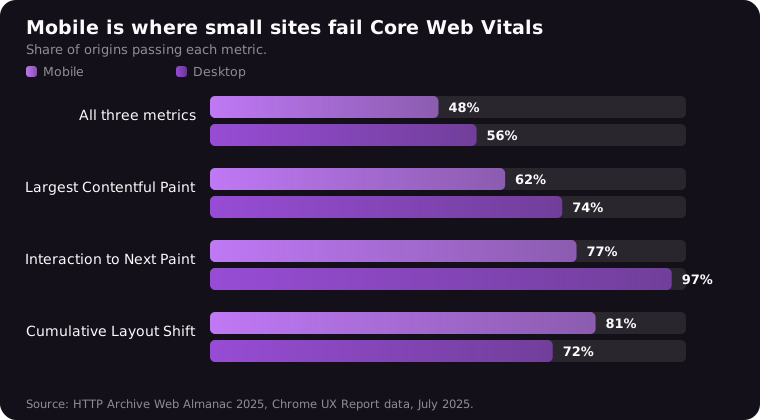
The mobile-desktop gap is where trades should focus. Your customers are outside, on a phone, with water coming through a ceiling. Here is how the web performed in July 2025, on Chrome's real-user data across a global sample.
| Metric | Mobile pass rate | Desktop pass rate |
|---|---|---|
| Overall "good" experience | 48% | 56% |
| Largest Contentful Paint | 62% | 74% |
| Interaction to Next Paint | 77% | 97% |
| Cumulative Layout Shift | 81% | 72% |
Source: HTTP Archive Web Almanac 2025, Performance chapter, Chrome UX Report, July 2025, global origins.
Look at Interaction to Next Paint. Desktop passes 97% of the time, mobile only 77%. That gap is the phone in your customer's hand struggling with scripts that felt fine on the office iMac. Largest Contentful Paint is the other fix, usually a hero image the size of a poster.
If your site runs on a website builder, how the main builders compare on a phone is covered separately.
What should a service page ask the visitor to do?
Give them a phone number and a form, and do not assume you know which they will use. UK data from Ruler Analytics covering over 110 million sessions puts Construction and Engineering at a 4.9% average conversion rate and Professional Services at 6.1%, against 5.13% across all industries (2026).
The channel split is worth pinning to the wall. In that same UK dataset, organic search converted at 4.9% on average. For Professional Services, organic reached 8.1%, the highest of any channel, ahead of paid at 6.7%, AI referral at 6.0% and social organic at 1.7%. People who found you by searching are further along than people you interrupted.
Calls versus forms, framed correctly
Now the split that gets misquoted constantly. Ruler Analytics measured the share of tracked conversions arriving by each route. Construction and Engineering came out at 22.2% calls and 77.8% forms. Professional Services split 52.6% to 47.4%, and Legal reached 56.3% calls.
Read that carefully. It is a share of conversions, not a conversion rate. It does not mean calls perform better than forms. It tells you how enquiries arrive in your sector. If three quarters of construction enquiries land as forms, somebody has to answer them the same day.
One more reason the page has to hold up. BrightLocal's 2026 survey found 54% of consumers visit the business's website after reading positive reviews, from a US panel of 1,002 adults. Reviews send people to your site. The site finishes the job.
What goes on the first screen decides whether it does.
Does schema markup make a service page rank?
Not the way it is usually sold. LocalBusiness is a supported rich result type in Google's documentation, requiring name and address, with telephone, geo, openingHoursSpecification and aggregateRating recommended. Service is different. It is valid schema.org vocabulary, but it does not appear in Google's Search Gallery at all.
So Service markup across forty pages is housekeeping, not a lever. It produces no rich result. Google is explicit anyway: "Google does not guarantee that features that consume structured data will show up in search results."
The practical setup is boring. One accurate LocalBusiness block, or a subtype such as Plumber or Electrician, on your home or contact page. Get the name, address and phone number right, then move on.
A service page skeleton you can copy
Nine blocks, in order. Nothing here needs a developer.
- H1 naming the service and the area once. Not three towns.
- A 50-word answer paragraph. What the job is, who it is for, how fast you can get there.
- Phone number and form, both visible without scrolling.
- What the job actually involves. Steps, in order, plain English. First-hand expertise shows up here.
- What affects the price. Not a price. Access, age of property, parts, out of hours.
- Proof tied to this service. A job you did: the problem, the fix, the timescale.
- Coverage, stated honestly, matching your Google Business Profile service area.
- Three or four questions customers actually ask on the phone.
- A closing prompt with the phone number repeated.
Then the tests. Your H1 should agree with a title tag of 51 to 60 characters. Blocks four, five and six should be impossible to move to another town's page without rewriting. If they are not, you have a template, not a page.
Frequently asked questions
How many location pages can I have before Google penalises me?
Google publishes no threshold and never has. Its spam policies test for "substantially similar pages" and for pages that "funnel users to one page", not for page counts. Three genuinely distinct pages are fine. Sixty templated ones are exposed under both the doorway and scaled content abuse policies.
Is one page per service safe?
Yes, on the evidence available. Nothing in Google's spam policies discourages a distinct page for each distinct service you offer. The policies target near-duplicate geographic variants, not different services. A boiler repair page and a bathroom installation page are not substantially similar.
How many words should my service page be?
No credible study measures word count against local service page performance, and Google's helpful content guidance specifies no word count anywhere. Write until the customer's questions are answered. Any agency quoting a target figure is repeating a number somebody invented.
Can I use AI to write my town pages?
Only with real care. Google's scaled content abuse policy explicitly names "using generative AI tools or other similar tools to generate many pages without adding value". The tool is not the problem. Generating many near-identical pages is, and that is what AI makes easy.
What to do this week
Six jobs. None takes longer than an evening.
- Run the substitutability test on three town pages. Swap the town name. If it reads identically, you have found your problem.
- Count your title characters. Anything over 70 is rewritten almost every time. Aim for 51 to 60.
- Make each H1 agree with its title. Agreement raised number preservation from 74.2% to 97.3% in Zyppy's data. Cheapest fix here.
- Open your two most important pages on your own phone, on mobile data. Only 48% of origins passed Core Web Vitals on mobile globally in July 2025.
- Check who answers your forms, and how fast. Construction enquiries arrived as forms 77.8% of the time in Ruler Analytics' UK data.
- Delete the town pages you cannot defend. Consolidate thin ones into a single strong page.
The unglamorous truth is that a few pages written by someone who has done the work beat forty spun ones. At Business Opt we usually remove more pages than we add in the first month of a trades site.
One page per service. Coverage you can actually reach. Specifics that could not be moved anywhere else. That is the whole structure.